
-

Trusted alongside
French notaires, estate agents, mortgage brokers and international banks.
Hear from a partner we work with in France
One of the partners we work with on the ground shares their experience of the French buying journey, and what makes it run smoothly.
A partner’s perspective:
From one of our French property partners
In English & French
THE JOURNEY
The French purchase process
The French system runs through the notarial framework. Here is the path from offer to keys, and the currency moment attached to each stage that matters.
-

Offer accepted
Agreement is reached with the seller on price and terms.
-

Sales agreement
The preliminary contract is signed by both parties and sets the timeline.
-

10-day cooling-off period
The buyer may withdraw without penalty.
-

Deposit (usually 5 to 10%)
Funds are transferred to the notaire’s escrow account.
Currency note: Your deposit is your first euro transfer. Preparing it early, with the funds verified, keeps you to the notaire’s deadline.
-

Legal & mortgage period (60 to 90 days)
Searches, diagnostics and mortgage approvals are completed.
Currency note: Between signing and completion the euro cost of your purchase can move. You can fix your rate in advance, so the cost is known rather than left to chance.
-

Completion, the acte de vente
The final balance must be received and cleared before signing.
Currency note: Cleared completion funds, in euros, in the notaire’s account on time. We structure the transfer around your signing date.
Why currency matters
A small percentage is a large number
On a purchase this size, a 2% difference is the figure shown here. It can come from two places:
1. The bank’s spread
High street banks quietly build a margin into the exchange rate they give you, often 2 to 4%, on top of any transfer fee. It rarely shows up on a statement.
2. Market movement
Rates also move every day between your offer and your completion. We quote against the interbank rate so the cost is visible, and we time transfers around your purchase, not the market.
Funding, done properly
More than
transferring money
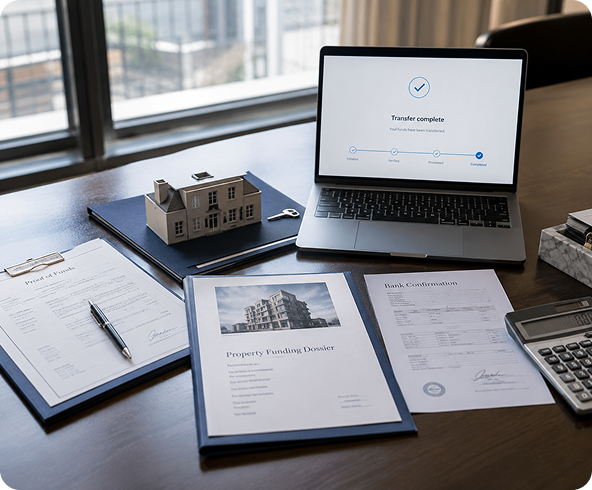
International buyers are usually asked to evidence where their money comes from, and to move it in a structured, documented way. We prepare this with you in advance.
Typically required
-

Proof of funds (preuve de fonds)
-
Evidence of source of funds (provenance des fonds)
-
Bank confirmations
-
Structured deposit and completion transfers
-
Mortgage drawdown coordination
Working with notaires & lenders
Every part aligned, so nothing delays signing
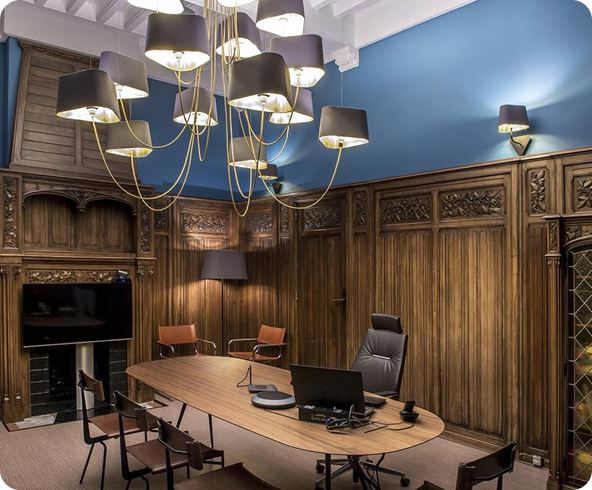
Where a mortgage is involved, funding is split across the deposit, the mortgage advance and the final balance. We regularly coordinate:
-
Escrow account confirmations
-
IBAN validation (RIB format)
-
Mortgage drawdown timing
-
Partial releases
-
Final completion transfers
Budgeting
Costs to budget for
Beyond the purchase price, plan for these.
-

Notaire fees
Typically 2 to 3% on new builds, 7 to 8% on older properties.
-

Estate agent fees
Often 4 to 8%, and usually negotiable.
-

Surveys & diagnostics
Mandatory diagnostic reports, plus any structural survey you commission.
-

Legal & translation
Independent legal or translation support where you want it.
Diagnostics & surveys
French sales require diagnostic reports covering, among others:
Septic compliance
Asbestos
Termites
Lead (CREP)
Energy performance (DPE)
Natural & industrial risk
Electrical & gas safety
Removal & relocation
Allow for moving and relocation costs, and for setting up locally once you complete. International buyers often add a structural survey for extra reassurance.
Popular locations
From Paris apartments to country homes

Paris & major cities
Paris, Lyon, Bordeaux and Nice, chosen for infrastructure, connectivity and long-term value.
Dordogne & the southwest
Dordogne, Charente and Brittany, favoured for space, character and a slower pace.

Provence & the south
Provence and Occitanie, within easy reach of regional airports and hubs.
Normandy & Brittany
Normandy and Brittany, popular for coastline, character and easy access from the UK.
Selling & repatriation
Selling property in France
-

Sale proceeds are usually received into a French account.
-
Funds can then be repatriated to the UK, US or elsewhere.
-
Capital gains tax may apply, depending on your residency status.
-
Converting proceeds back into sterling or dollars deserves the same care.
Opening a French bank account
You will usually need photo ID, proof of address, and your compromis de vente if buying. Major banks include BNP Paribas, Crédit Agricole and Société Générale.
FAQ
What's the best way to pay a French notaire from overseas?
Do I need a French bank account to buy a property in France?
How much can I save by not using my bank for the transfer?
When should I lock in my exchange rate when buying in France?
What is a forward contract, and should I use one?
How long does it take to transfer money to France for a property purchase?
What proof of funds will I need to buy a property in France?
What are the total costs of buying a property in France?
How do I get my money back home after selling a French property?
Free download
The complete guide to buying & funding in France
-

The full French buying process
-
Legal & diagnostic requirements
-
Currency considerations
-
A pre-completion checklist
-
Proof & source of funds
-
Costs & budgeting
Get Your Free Guide here
PDF, free, no obligation.